Deep Dive: Thursday, October 1

```html

Thursday, October 1st — What Every Leaving Cert Student Should Be Working On Right Now

October 1st. There's something about this date that catches students off guard every year. The summer is fully buried. The October midterm is creeping up. And if you're sitting your Leaving Cert — Higher Level or Ordinary Level — the reality of what's ahead is starting to feel very real. I've watched hundreds of students hit this exact week and either buckle down or drift. The ones who drift almost always regret it come June.

So here's what I want to do today: give you a proper, subject-by-subject breakdown of what you should be focused on this week. Not vague motivational stuff. Actual content. Think of this as your Thursday briefing — the kind of targeted session you'd get from a good online tutor who knows exactly where the exam marks are hiding.

Mathematics: The Subject That Makes or Breaks CAO Points

Let's start with Maths, because for most Leaving Cert students it's the highest-stakes subject on the table. Higher Level Maths carries bonus points — 25 extra if you pass — and that bonus has completely changed how students approach the subject. But here's what I see go wrong constantly: students chase the bonus points without building the actual foundation first.

Calculus — Where Higher Level Maths Is Won or Lost

If you're on Higher Level, calculus is non-negotiable. Differentiation and integration appear on Paper 1 every single year, and the questions are almost always predictable in structure once you've seen enough of them. The chain rule, the product rule, integration by substitution — these aren't exotic. They're bread and butter.

Here's a worked example I use constantly with students:

Differentiate: f(x) = (3x² + 5)⁴

Chain rule. Outside function first, keep the inside, multiply by the derivative of the inside.

f'(x) = 4(3x² + 5)³ × 6x = 24x(3x² + 5)³

Simple when you see it broken down. But the common pitfall? Students forget to multiply by the derivative of the inner function. That last step — the ×6x — gets dropped under exam pressure all the time. Write it out in full. Every time. Don't try to do it in your head during a Leaving Cert paper.

Algebra and Sequences — Don't Neglect Paper 1 Part B

Sequences and series trip students up because they look simple but the arithmetic gets messy fast. The formula for the sum of a geometric series is given on your formulae booklet — but knowing when to use it and how to set up the equation correctly is a skill that only comes from repetition. Do three past paper questions on sequences this week. Time yourself. That's the practice strategy that works.

Statistics and the Data-Heavy Questions on Paper 2

Statistics on the Leaving Cert has expanded significantly over the past decade. Probability, normal distribution, hypothesis testing — these now carry serious marks on Paper 2. And yet, in my experience, they're the topics most students spend the least time on.

The normal distribution in particular is worth mastering. The question structure is almost always the same: you're given a mean and standard deviation, asked to find a probability. You standardise using z = (x − μ) / σ, look up the z-table, and interpret. Students lose marks not because they don't know the formula, but because they misread the table or forget to subtract from 1 when the question asks for a "greater than" probability.

If you're finding statistics genuinely difficult — not just unfamiliar, but confusing — it might be worth getting structured help. You can start a free 21-day trial with Thula Academy and work through it with a tutor who can spot exactly where the logic is breaking down for you.

Physics and Chemistry: October Is Foundation Month

For science students — and this applies whether you're sitting Irish Leaving Certificate, the IB, or A-Levels — October is foundation month. The temptation is to jump straight into past papers, but if the concepts underneath aren't solid, past papers just teach you to memorise rather than understand.

Physics: Forces, Energy, and Getting the Basics Right

In Physics, the most common mistake I see at this stage of the year is students learning definitions by rote without understanding the underlying mechanics. Newton's second law isn't just F = ma. It's the relationship between net force, mass, and acceleration — and "net" is the word that changes everything in a multi-force problem.

Work through force diagrams slowly. Draw them out. Label every force acting on an object before you write a single equation. It sounds tedious, but it's the difference between consistently full marks and consistently losing 2–3 marks per question for the wrong reason.

Organic Chemistry — The Topic That Never Goes Away

If you're doing Higher Level Chemistry, organic chemistry is your best friend if you let it be. The reactions follow logical patterns. Alkenes undergo addition reactions. Alcohols can be oxidised to aldehydes or carboxylic acids. Esters form through condensation reactions between alcohols and acids. Once you see the pattern, you can reason your way through an unfamiliar question rather than just trying to recall a memorised answer.

What I always tell my students at this stage: make a reaction map. Put functional groups in boxes and draw arrows between them showing what reagent causes the transformation. One page of A4. Stick it on your wall. You'll absorb it passively over the next few weeks just by walking past it.

Economics, Business, and Accounting: The Underestimated Subjects

Here's something I genuinely believe: Economics and Accounting are two of the most underrated H1 opportunities in the Leaving Cert. The marking schemes are generous. The questions are structured. And students who put in consistent, methodical effort almost always do well.

For microeconomics, make sure you can draw — neatly and accurately — supply and demand diagrams, including shifts. The examiner wants to see the diagram, the labels, and the explanation all working together. A correct diagram with no explanation gets half marks. An explanation with no diagram gets half marks. Both together? Full marks.

For financial accounting, it's all about format and accuracy. Final accounts questions follow a rigid structure. Practice laying out a Trading, Profit and Loss Account and Balance Sheet from scratch, without looking at the template, until it's automatic. If you want to explore structured support for these subjects, have a look at our tutoring plans — we cover Accounting and Economics at every level.

English and Essay Writing: The Skill That Transfers Everywhere

English gets treated as a "soft" subject, which is honestly one of the biggest misconceptions in secondary education. The Leaving Cert English paper — particularly the composing section — rewards students who write with genuine voice, clear structure, and the ability to develop an argument over several paragraphs. These are learnable skills. They're not talent.

One thing I find makes an immediate difference for students working on academic writing and essay structure: write your thesis before you write anything else. Not the introduction — the thesis. One sentence. What is this piece of writing actually arguing? Everything else — every paragraph, every example, every stylistic choice — should point back to that sentence.

If you're working through the comparative study or any of the prescribed texts, our free study tools include structured frameworks for literary analysis that students have used to seriously improve their English grades.

A Note for Students Across All Curricula

Everything I've covered here applies beyond the Irish Leaving Cert too. Whether you're working through the IB, AP exams, Cambridge A-Levels, or any other curriculum, the underlying challenge is the same: building conceptual understanding early enough that exam pressure doesn't strip it away. The student who walks into a Leaving Cert Higher Level Maths paper in June having genuinely understood calculus — not just practised it — is a different kind of calm to the one who's hoping muscle memory carries them through.

That gap? It opens right now, in October, based on the choices made week by week.

What to Actually Do This Thursday

Pick one subject. Not your favourite — the one you've been avoiding. Spend forty-five minutes on it tonight using the first principles approach: understand the concept before practising it. No past papers for that subject until you can explain the core idea out loud without looking at your notes.

That's it. One subject, forty-five minutes, first principles. If you do that consistently across October, you'll arrive at the midterm in a completely different position to where you are now.

And if you want someone sitting across from you — virtually — making sure you're actually working through the right things in the right order, that's exactly what a good online tutoring relationship looks like. The students I've seen make the biggest gains aren't always the most naturally gifted. They're the ones who get consistent, targeted feedback early enough to act on it.

October is still early enough. Use it.

```
Skip to main content
∑
∫
π
∞
√
θ
Δ
Ω
λ
Φ
∑
∫
π
∞
√
θ
Δ
Ω
λ
Φ
∑
∫
π
∞
√
θ
Δ
Ω
λ
Φ
∑
∫
π
∞
√
θ
Δ
Ω
λ
Φ
Welcome to Thula Academy

Where Learning Clicks.

Whether you're studying Cambridge, Edexcel, IB, AP, CBSE, or any other curriculum, we adapt our expertise to your syllabus. Leave anxiety behind and step into a personalized ecosystem designed to build unshakeable confidence.

⚡ 21 days full access · No credit card required · Instant activation

Plans from $69/month · Free 21-day trial included

Why We Stand Out

Unlike Khan Academy, Coursera, or traditional tutoring, Thula Academy is a premium ecosystem offering Intelligent Auto-Grading for Handwritten Work, a gamified War Room, and Multi-Board Mastery (Cambridge, Edexcel, IB, AP).

Smart Auto-Grading
War Room Analytics
Automated Exam Proctoring
See Full Comparison Matrix
Study Room Demo

Interactive Learning Environment

Experience our Hybrid Tutors that dynamically adapt to your learning pace, generating visual aids and personalized curriculum on the fly.

Try the Live Demo

Enter your details to unlock all interactive demos

No spam. We respect your privacy.

THULA LMS • STUDY ROOM
Demo Student • Cambridge

Processing...

The Architect Demo

Procedural Content Engine

Watch how our system constructs structured study paths from raw materials, perfectly aligned with Cambridge and IB standards.

Try the Architect Demo

Enter your details to unlock all interactive demos

No spam. We respect your privacy.

THE ARCHITECT

Advanced Exam Paper & Material Generation

D
Demo Student

Paper Parameters

No specific topics added (Will cover Full Syllabus)
Exam Paper Preview

READY TO GENERATE PAPER

The Examiner Demo

Automated Grading

Experience instant, granular feedback on handwritten answers and complex problem-solving based on official marking schemes.

Try the Examiner Demo

Enter your details to unlock all interactive demos

No spam. We respect your privacy.

THE EXAMINER

Upload multiple pages of questions & answers for comprehensive analysis.

Academic Context

1. The Question(s)

2. Your Answer(s)

[WAITING FOR INPUT DATA]
Video Demos

See the Platform in Action

Watch real walkthroughs of every key feature — from adaptive lessons to instant grading and analytics.

Study Room: Experience the adaptive Study Room — real-time personalized lessons that adjust to your understanding.

1 / 5
Curriculums

Trusted by Students Across All Major Exam Boards

GLOBAL

ALL SYLLABUSES

CAMBRIDGE & EDEXCEL

INTERNATIONAL

IB

DIPLOMA

AP

ADVANCED PLACEMENT

GCE

A-LEVEL / O-LEVEL

AQA & OCR

UNITED KINGDOM

VCE & HSC

AUSTRALIA

LEAVING CERT

IRELAND

UNIVERSITY

UNDERGRADUATE

CBSE & ICSE

INDIA

NCEA

NEW ZEALAND

WACE & SACE

AUSTRALIA

CAPS

SOUTH AFRICA

Why Most Students Struggle - And How We Fix It

Traditional Tutoring

  • Passive listening - students memorize, not understand
  • One-size-fits-all approach ignores individual gaps
  • No tracking - parents have zero visibility
  • Exam anxiety goes unaddressed
  • Homework grading takes days, loses momentum

The Thula Strategy

  • Phenomenon-Based Learning - students discover, not memorize
  • Hybrid tutors adapt in real-time to YOUR cognitive load
  • War Room analytics with Sigma Score - parents see everything
  • Built-in Stress Reset Buddy for exam season wellness
  • The Examiner grades homework instantly via WhatsApp photo
See What's Inside

A Virtual Campus. Not Just a Course.

Real screenshots from our platform. This is not a mockup - it's what your child will use every day.

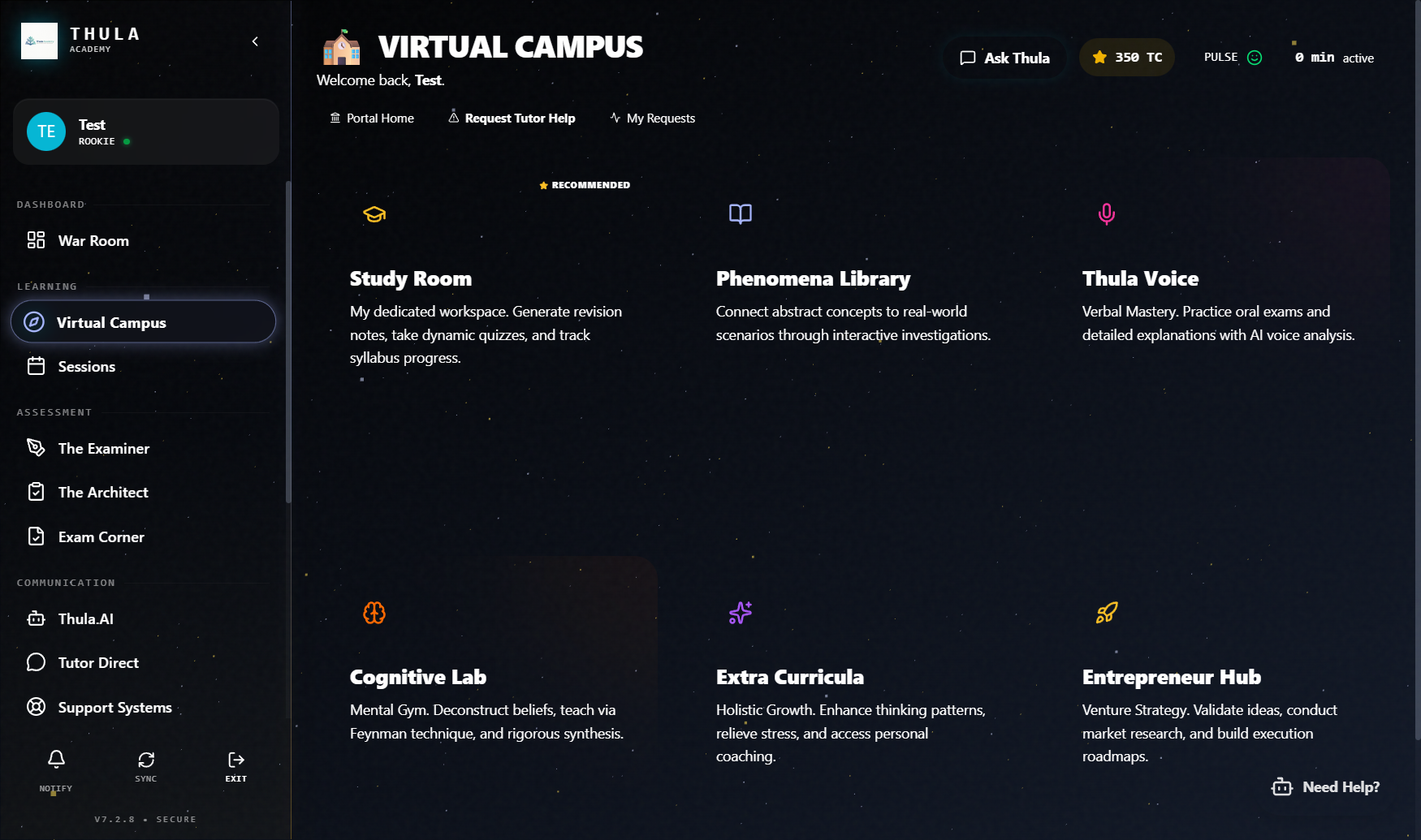
Virtual Campus - Your Digital Hub

Virtual Campus - Your Digital Hub

Virtual Campus

6 specialized rooms - Phenomena Library, Study Room, Cognitive Lab, Entrepreneur Hub, Thula Voice, and Extra-Curricula Corner.

Hybrid Tutors (Alex, The Examiner, The Architect)

Voice & chat tutoring that adapts to your pace. Instant grading. Custom exam papers on demand.

War Room Analytics

Sigma Score (∑), Rank Progression, Blind Spot Detection, and automated strategic reports.

WhatsApp Neural Link

24/7 access to hybrid tutors directly through WhatsApp. No app download needed.

Explore all features

Verifiable Outcomes

Verifiable results. Not promises.

0x

Faster Assessment

Turnaround with automated grading

0%

Admin Reduction

Through complete automation

0/7

Mentorship Access

Via WhatsApp Neural Link

0+

Exam Boards

Cambridge, Edexcel, IB, AP & more

0+

Study Modes

Inquiry, assessment, voice & more

<0s

Avg Grading Time

Handwritten work graded in seconds

For the Institution

  • Scalable prestige — elite education to thousands
  • Complete exam, grading & material automation
  • War Room analytics with cohort oversight
  • Automated exam proctoring & behaviour analysis
  • Zero overhead — fully automated reporting

For the Student

  • Accelerated mastery through PhBL methodology
  • Elimination of knowledge gaps & blind spots
  • Voice-interactive tutoring in 18+ modes
  • SRS flashcards & spaced repetition for retention
  • Observable increase in academic confidence

Platform Impact

Real numbers from our learning platform

🎓
0+

Students Enrolled

📄
0+

AI Exam Papers

👩‍🏫
0+

Tutoring Sessions

🤖
0+

AI Operations Run

📚
0+

Digital Resources

🌍
0+

Countries Served

The Cognitive Lab: 4 Tools for Deep Mastery

A rigorous intellectual gymnasium designed to reconfigure how students think - transitioning from surface-level cramming to long-term mastery.

The Feynman Tutor

Inverse-tutor mode: students teach the system to truly master concepts. If you can't explain it simply, you don't understand it.

First Principles

Breaking complex problems into fundamental truths. Strip away assumptions and rebuild from the ground up.

PreMortem Analysis

Identifying pitfalls and engineering bulletproof exam strategies before they're needed. Anticipate failure, then eliminate it.

Synthesis Engine

Cross-domain pattern recognition and lateral thinking training. Connect ideas across subjects for breakthrough insights.

Thulnitha De Silva - Founder of Thula Academy
Meet the Strategist

Thulnitha De Silva

8+ years academic success stories across Cambridge, Edexcel, IB, AP & all global curricula. Moratuwa Engineering Faculty alumnus, currently pursuing a BSc in Mathematics and developing new learning theories.

Students don't just pass exams - they dominate them. The Grandmaster Strategy produces consistent placements at Cambridge, Imperial College, MIT, and NUS.

Read Full Bio

Trusted by Students Across the Globe

Online academic tuition serving students in the UK, Australia, Singapore, UAE, Ireland, Germany, and Sri Lanka.

Sri LankaSri LankaUnited KingdomUnited KingdomAustraliaAustraliaIrelandIrelandGermanyGermanyUAEUAESingaporeSingaporeUSAUSA
Real Success Stories

Don't Just Take Our Word For It.

S

Sarah L.

A-Level Economics Student
"The Topic Studio completely transformed how I understand Macroeconomics. The tutor breaks down complex policies step-by-step."
UKUKInvalid Date
A

Ahmed M.

IB Physics Student
"The Architect generated mock exams that matched my real finals perfectly. The handwriting grading caught my diagram errors."
UAEUAEInvalid Date
J

Jessica T.

AP Biology Student
"The Examiner feedback is brutal but exactly what I needed. It identified that I was losing marks on my experimental design questions."
USAUSAInvalid Date
D

David K.

Parent (VCE Student)
"Best investment we made for our son. The Hybrid Tutors are available 24/7 for Maths, Chemistry and Physics."
AustraliaAustraliaInvalid Date

Ready to Find Your Strategy?

Join the elite community of students who are not just learning subjects - they're mastering the art of strategic thinking.

From $69/month · 21 days free · No credit card required

Frequently Asked Questions

Everything you need to know about the Grandmaster Strategy.

Thula Academy is an Intelligent Tutoring System covering ALL subjects — Mathematics, Physics, Chemistry, Biology, Economics, Business Studies, Psychology, Geography, English, and more — across Cambridge CAIE, Edexcel, IB Diploma, AP, IGCSE, GCSE, and University curricula. Students from 10+ countries use Thula Academy with a 4.9/5.0 rating.
Thula Academy offers a 21-day free trial! Paid plans start at $69/month, Annual at $468/year (saving 43%), and Lifetime at $1,499 one-time. All plans include full LMS access, Triple Intelligent Tutoring (Digital Educator, The Examiner, The Architect), and unlimited sessions.
Unlike Khan Academy and Coursera, Thula Academy offers full Intelligent auto-grading for handwritten work, voice-interactive teaching, and Intelligent exam proctoring. Unlike Byjus, Thula Academy provides a multi-board curriculum with an advanced Spaced Repetition System (SRS) flashcards and gamified War Room analytics.
Thula Academy is the only major online tutoring platform that provides Intelligent auto-grading for handwritten work via The Examiner, alongside Intelligent exam proctoring and behavior analysis.
Yes. Thula Academy offers a 21-day free trial and diagnostic assessment that identifies your exact conceptual gaps using Smart Analytics. No credit card required. The diagnostic maps weaknesses across all syllabus areas and creates a personalised study plan.
Thula Academy covers every academic subject: Mathematics, Further Mathematics, Physics, Chemistry, Biology, Economics, Business Studies, Accounting, Psychology, Geography, English Language, and more. All subjects are available across Cambridge, Edexcel, IB, AP, and University curricula.

From $69/mo · 21 days free

See Pricing