Inside Thula Academy — Exam Corner: Sunday, September 27
The Sunday Night Panic — And Why Exam Corner Changes Everything
It's 9pm on a Sunday. Your Cambridge A-Level mocks are six weeks away. You've done some revision — you think — but you genuinely can't tell if you're on track or quietly falling behind. You've taken a few practice papers scattered across different folders, you've got some marked scripts somewhere, and your tutor mentioned last week that your data handling questions need work. But where does all of that actually live? Where's the thread?
That's not a niche problem. I've been working with students across the UK, UAE, Singapore, Australia, Ireland, and the US for years, and I'd say that disorganised exam preparation is probably the single most common thing holding capable students back. Not ability. Not effort. Organisation. Specifically — having nowhere central to track what you've done, what it showed about you, and what you need to do next.
That's exactly what we built Exam Corner to solve.
What Exam Corner Actually Is (And Isn't)
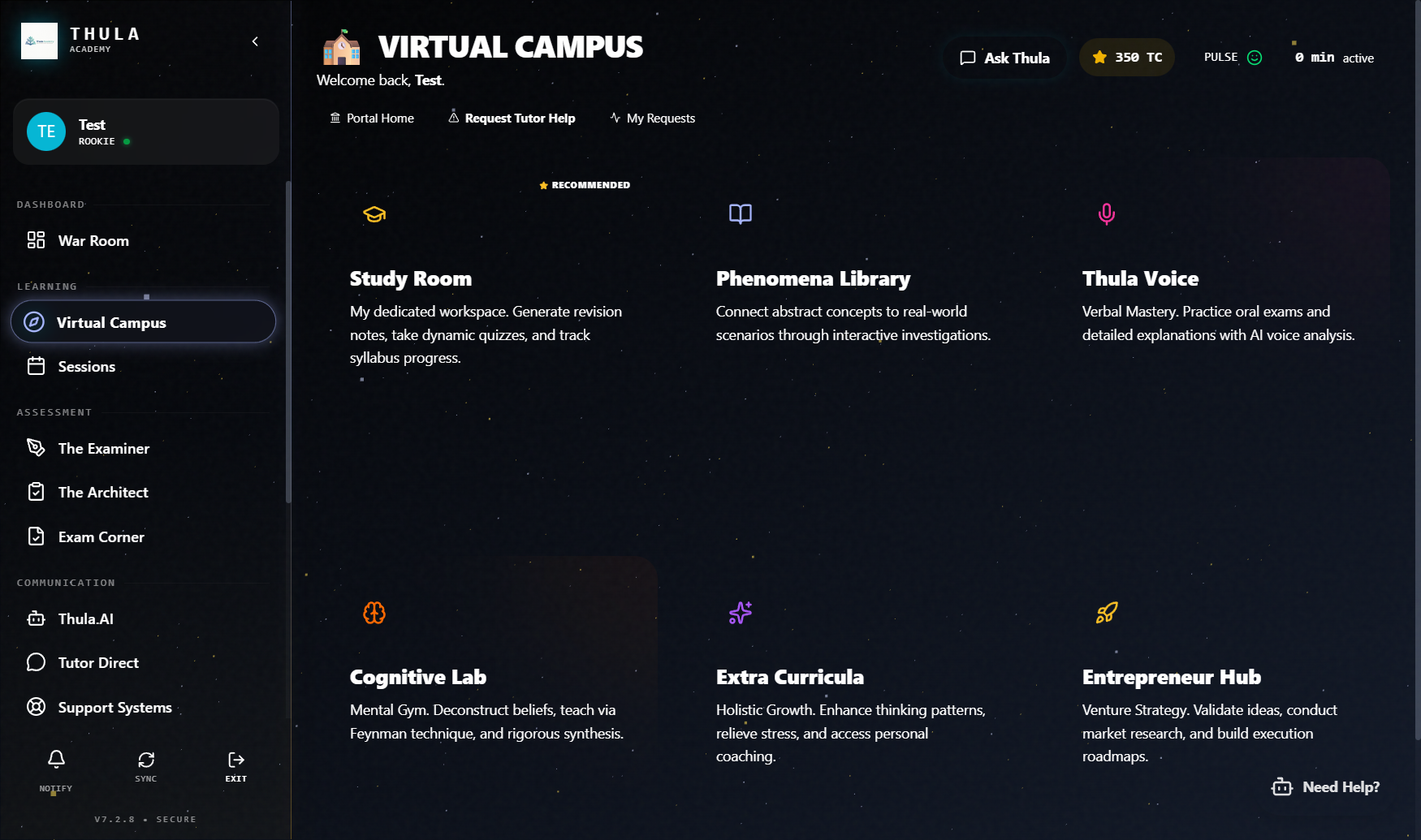
Exam Corner is the dedicated exam hub inside the Thula Academy virtual campus. It's where students take tests, receive results, and track their entire exam journey — all in one place. Not a spreadsheet. Not a folder of PDFs. An actual system that remembers what you've done and shows you where you stand.
I want to be clear about what it isn't, though. It's not a glorified quiz tool. It's not the kind of thing where you answer ten multiple choice questions and get a score out of ten that means nothing. Exam Corner is built around real exam preparation — the kind that reflects how Cambridge, Edexcel, IB, and AP papers actually work. Structured questions, topic coverage, mark-scheme logic. The experience is meant to feel like sitting a real paper, not clicking through flashcards.
And the results you get back? They're not just scores. They're data points in an ongoing picture of your progress.
A Real Student Scenario — Meet Aisha
Let me walk you through how this actually plays out in practice. Aisha is a Year 12 student in Dubai following the Edexcel A-Level Economics syllabus. She's working with one of our online tutors at Thula — sessions twice a week — and she's genuinely motivated. But Economics has a lot of moving parts. Macroeconomics, microeconomics, quantitative skills, essay structure. It's a lot to hold in your head.
Before Exam Corner, Aisha's revision looked like this: do a past paper, maybe mark it, maybe not, make a vague mental note that "diagrams need work," and carry on. The problem is that vague mental notes are useless six weeks later when you're trying to remember what you actually struggled with in October.
Now — same student, same subject — she opens Exam Corner at the start of her study session. She can see every test she's taken, when she took it, what she scored, and which topics those scores broke down across. Her tutor can see the same thing. When they sit down for their Tuesday session, they're not starting from scratch trying to diagnose where the gaps are. The data is just there.
The Bit That Surprised Me Most — Student Progress Tracking That Actually Means Something
Here's the thing that I didn't fully anticipate when we were putting this together. The tracking isn't just useful for tutors — it changes how students relate to their own progress. There's something psychologically different about seeing your exam journey laid out visually versus trying to hold it all in your memory.
Aisha told her tutor that seeing her scores improve on market failure questions over three consecutive tests made the work feel worth it in a way that was hard to explain. That's not a small thing. Motivation in the middle stretch of A-Level prep is genuinely fragile, and anything that makes the effort feel visible and real matters.
I've seen this with IB students too — particularly IB Maths, which is brutal in terms of volume. When a student can open their exam history and see that their calculus performance has moved from 54% to 71% over eight weeks, that's not just a number. That's evidence that they're doing something right. It's the kind of thing that keeps you going on a Sunday night when everything feels hard.
How the Exam Flow Actually Works Inside the Platform
When a student sits down to use Exam Corner, the experience is clean and deliberate. They select a subject, pick a topic or a full mixed paper, and the platform serves up a properly structured test. When it's done, results are processed and stored — permanently — in their exam history. Every attempt. Every score. Every topic breakdown.
This sits inside the broader Thula Academy virtual campus, which includes the Study Room for day-to-day learning, the Topic Studio for building subject knowledge, and the War Room for intensive exam sprint sessions. Exam Corner is the piece that ties the assessment side together. Think of it like a report card that updates in real time, except it's actually useful and not just a number your parents look at once a year.
For tutors delivering online academic tutoring through the platform, this changes the whole shape of a session. Instead of spending 20 minutes at the start of a lesson figuring out where the student is, you already know. You can use that time to actually teach. That's not a small efficiency gain — across a six-week revision block, that's hours of teaching time recovered.
Why This Matters More Than You Might Think for International Exam Students
One thing I feel strongly about — and this is maybe the non-obvious point worth making — is that this kind of personalised exam tracking matters more, not less, for students sitting international exams like Cambridge IGCSE, A-Levels, or IB.
Here's why. If you're a student in Singapore or Ireland sitting Cambridge A-Levels, you're not in a UK school with a teacher chasing you down the corridor asking about your mock performance. You might be working with a Cambridge tutor online and studying largely independently. The structures that keep domestic students accountable — regular school assessments, teachers who know your face — aren't always there. You need a system that creates those feedback loops for you. That's exactly what Exam Corner does.
The same goes for AP students in the US or VCE students in Australia working with an online tutor between regular school commitments. The platform's tutoring plans are built around this kind of independent, self-directed learner who needs structure without needing someone to stand over them.
What Good Exam Preparation Actually Looks Like in Practice
I always tell my students: the goal of practice papers isn't to practice — it's to generate information. Every test you sit should be telling you something specific. Which topics are solid. Which ones fall apart under exam conditions. Where your timing breaks. What kinds of questions you consistently misread.
If you're doing practice papers and the only output is a score out of 80 that you scribble in the margin, you're leaving most of the value on the table. Exam Corner is built around the principle that every assessment should feed back into a clearer picture of where you are and what you need next. That's smart exam preparation — and it's the kind of thing that separates students who feel vaguely prepared from students who actually are.
If you've been managing your exam prep through a mix of downloaded papers, notes app reminders, and optimistic guesswork, start your free 21-day trial and spend twenty minutes inside Exam Corner. You'll see pretty quickly what it's like to have all of that in one place.
One Last Thought
Every student I've worked with who's performed well under exam pressure has one thing in common: they knew themselves as an exam-taker. They knew their weak spots. They knew what happened to their essay structure when they were stressed. They knew which topics needed another pass. That self-knowledge doesn't come from doing more work — it comes from doing work that generates feedback and actually paying attention to what that feedback says.
Exam Corner won't revise for you. But it will make sure that every hour you put in is building something you can see, measure, and act on. And in the long run, that's the difference.
```

 Sri Lanka
 United Kingdom
 Australia
 Ireland
 Germany
 UAE
UAE Singapore
 USA
USA