Inside Thula Academy — Study Room: Monday, October 19
Monday, 19th October — A Snapshot of What Learning Looks Like at Thula Academy
There's a specific kind of frustration I've watched students carry into revision season year after year. They've got the textbook open, the past papers printed, maybe a highlighter in hand — and they still feel completely lost. Not because they haven't tried. But because nobody's actually checked whether the foundation is solid before throwing exam questions at them. It's like asking someone to run before confirming they know how to stand up.
That's the problem the Study Room was built to fix. And honestly, once you see it in action, it's hard to go back to doing things the old way.
What the Study Room Actually Is (And Isn't)
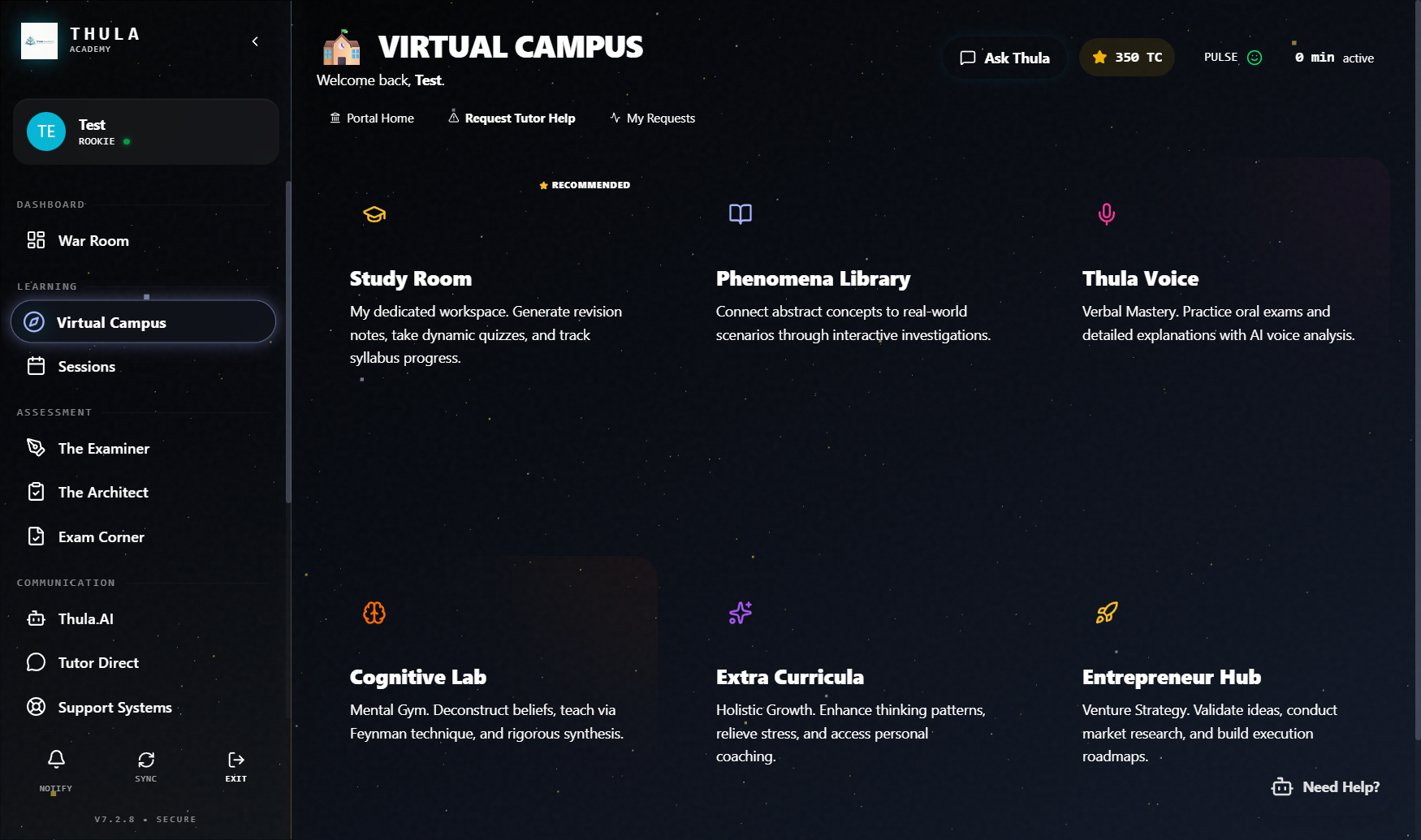
I want to be upfront: the Study Room isn't a video library. It's not a passive "watch-a-lesson, hope-for-the-best" experience. It's an interactive learning space where students move through content topic by topic, with comprehension checks built in at every stage — so there's no quietly drifting through material without actually understanding it.
Think of it less like a classroom and more like a really good conversation with a tutor who refuses to move on until you've genuinely got it. Every topic is structured, every step is deliberate, and the path adjusts based on what you're showing you understand. That's what I mean when I say it's personalised education in the truest sense — not just a different colour scheme for each student, but a genuinely different journey.
For A-Level students in the United Kingdom juggling Edexcel Maths, AQA Biology, or OCR Chemistry alongside UCAS personal statements and mock season — this matters enormously. The time pressure is real. You can't afford to spend three hours on content you already know, and you definitely can't afford to skip past something you don't.
Let Me Walk You Through a Real Monday Morning
It's 9:15am. Mia is in Year 13 in Manchester, doing Cambridge International A-Levels — Chemistry, Maths, and Economics. She's got a school mock on Electrochemistry in two weeks and she already knows that redox reactions are her weak spot. She's been putting it off because every time she reads the textbook chapter, it feels like a wall of symbols with no obvious entry point.
She opens the Study Room on her laptop.
Instead of being handed a 47-page chapter, she's presented with a structured topic path: Oxidation States → Half-Equations → Electrochemical Cells → EMF Calculations. Each node is a focused teaching unit — not overwhelming, not oversimplified. She starts at Oxidation States because the system flagged it as a gap from her last session's comprehension check.
Here's the thing though — she doesn't just read through it. At three points during the unit, she hits a comprehension check. Not a high-stakes test. More like the Study Room pausing and asking, "Right, did that land?" If it did, she moves forward. If it didn't, she gets a slightly different explanation — a different angle, a worked example, a concrete analogy. The topic doesn't let go of her until she's actually ready.
By 11am, Mia has covered two full topic nodes with genuine understanding. That might not sound like much. But compare it to two hours of passive reading followed by a mild panic — and the difference is enormous.
Why Topic-by-Topic Structure Changes Everything for Exam Preparation
I've spoken to hundreds of students over the years — GCSE students working through AQA Maths, sixth formers on Edexcel A-Level Economics, IGCSE candidates doing Cambridge Sciences — and the single most common mistake I see is treating revision like a checklist rather than a construction project.
You don't pass an A-Level by reading every topic once. You pass by building genuine conceptual structures — where each thing you understand is actually connected to something else you understand. The Study Room forces that kind of layered learning by design. You can't rush to the "hard stuff" if the foundation isn't there. The comprehension checks catch the gaps before they become exam-day disasters.
There's a non-obvious insight here that I think most tutoring platforms completely miss: the moment of not-understanding is actually incredibly valuable — if it's caught in time. A student who hits a comprehension check, gets it wrong, and then works through a clearer explanation has just had a genuinely formative learning moment. That's worth more than an hour of smooth, frictionless reading that went in one eye and out the other.
If you're curious about what else Thula Academy's platform offers beyond the Study Room, try our free study tools — there's quite a lot to explore.
What Students Are Actually Telling Us
One of our students — doing WJEC A-Level Psychology in Wales — told me she'd never felt like she "owned" her revision before. She described previous studying as performative. She'd sit at her desk, go through the motions, feel like she'd done the work, and then get to a past paper question and draw a blank. The Study Room changed that because it kept asking her to prove her understanding, not just acknowledge the content.
That's not a small thing. That's the difference between surface-level familiarity and actual exam-ready knowledge.
And for students working with an online tutor alongside their independent study — which many of our students do — the Study Room creates a much more productive tutoring relationship. When a student comes to a session having already worked through the topic foundations, the tutor can spend that hour on higher-order thinking, tricky application questions, and exam technique. Not re-explaining what oxidation states are from scratch.
How Personalised Study Paths Actually Work in Practice
The Study Room doesn't give every student the same path. That's the whole point. A student who breezes through the comprehension checks on a topic moves faster and gets pushed into more challenging material sooner. A student who struggles gets more support, more examples, more time — without ever feeling like they're falling behind, because the path is theirs.
This is what adaptive tutoring actually looks like in practice. Not a system that decides you're "Level 3" and locks you there. A system that responds to what you're showing it, session by session, topic by topic.
For students sitting Cambridge CAIE exams, AQA A-Levels, or Edexcel IGCSEs — where the mark schemes reward precise understanding rather than vague familiarity — this kind of personalised study path isn't a luxury. It's genuinely the most efficient way to prepare. You're not wasting time on what you know. You're investing it in what you don't. That's smart exam preparation in the most literal sense.
If you want to understand how this fits into the broader platform — explore our tutoring plans and see which tier gives you access to the Study Room and everything around it.
One More Thing Worth Saying
I know there are a lot of platforms out there positioning themselves as the answer to every student's problem. I'm not going to do that. What I will say is that the Study Room was built out of a genuine frustration — mine, and the frustration of every educator who's watched a capable student fail not because they weren't bright enough, but because nobody caught their gap at the right moment.
That's what student progress tracking should actually mean. Not a dashboard of completion percentages. Real insight into where understanding is solid and where it's fragile — so that the next learning session can be targeted, deliberate, and actually useful.
Mia, by the way, sat her mock two weeks after that Monday morning session. She told me the Electrochemistry question felt, for the first time, like something she'd genuinely prepared for rather than something she'd hoped wouldn't come up. That's the goal. Every time.
If that sounds like what you — or your student — needs right now, start your free 21-day trial and spend a Monday morning in the Study Room. See what it feels like to actually know the material.
```

 Sri Lanka
 United Kingdom
 Australia
 Ireland
 Germany
 UAE
 Singapore
 USA