Inside Thula Academy — Study Room: Monday, October 5
Monday, October 5 — A Snapshot of What Learning Actually Looks Like at Thula Academy
There's a particular kind of panic that sets in around October for sixth formers. The summer is properly gone, the first round of school assessments is either looming or already done, and somewhere in the back of your mind you're quietly calculating how many months you have left before your A-Level exams. I've spoken to hundreds of students in exactly this position — sitting in front of a textbook, highlighting the same paragraph three times, and genuinely not knowing whether any of it is sticking.
That gap — between covering content and actually understanding it — is the thing that keeps me up at night. And it's exactly the problem the Study Room at Thula Academy was built to close.
What Is the Study Room, Exactly?
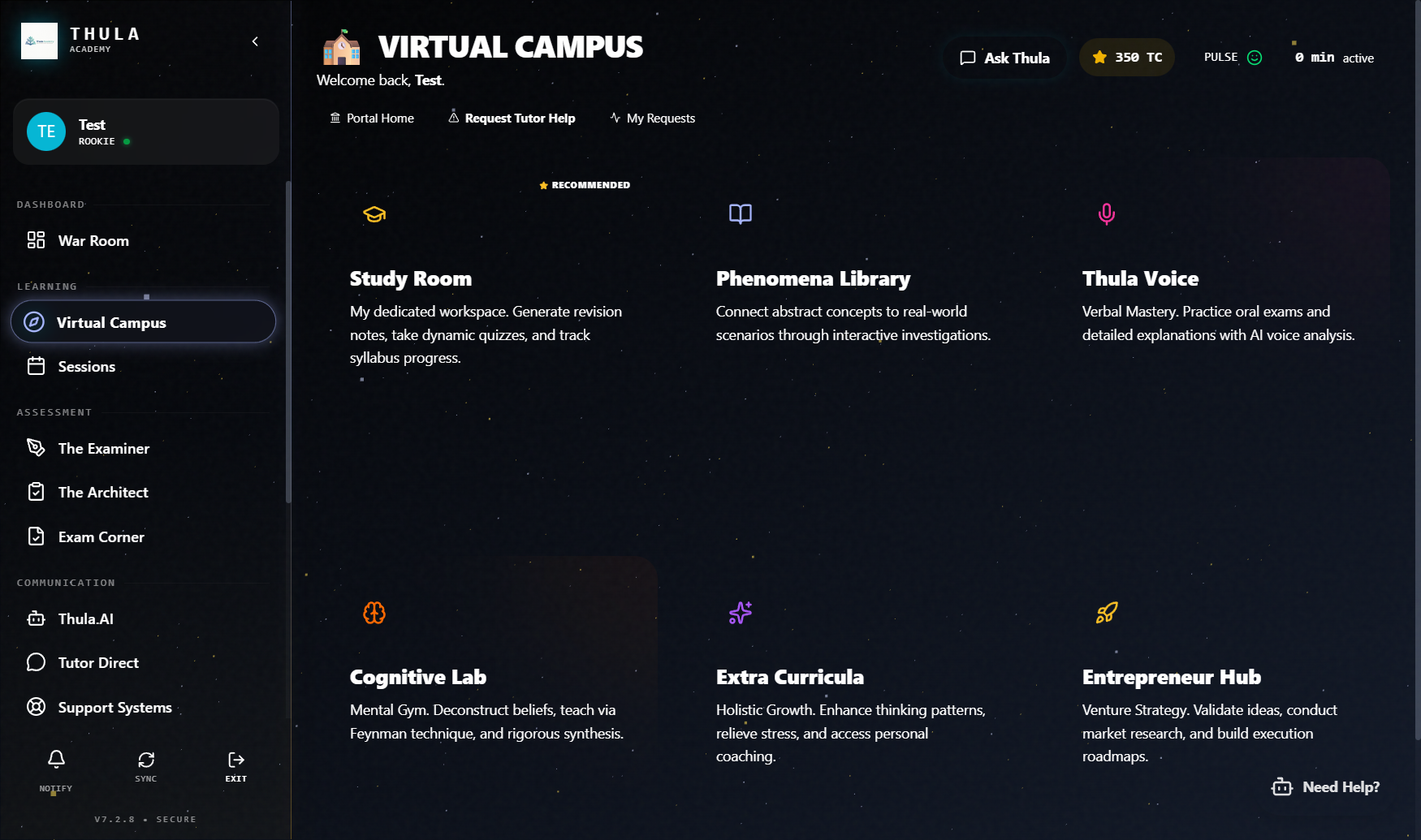
The Study Room is our interactive learning space inside the Thula Academy platform. Think of it less like a library and more like sitting with a really good teacher who has infinite patience and a very structured plan. It works topic by topic — so rather than throwing a student at a full A-Level Chemistry course and hoping they find their footing, it breaks learning down into digestible units with proper teaching built in.
What makes it different from just watching a YouTube video or reading a revision guide is the comprehension checks woven throughout. You're not just consuming content — you're being tested on it in real time, and the platform adjusts based on how you respond. If you nail the first few checks, it moves you on. If you're shaky on a concept, it slows down and reinforces it. That's personalised education in the truest sense — not a buzzword, just genuinely responsive learning.
For students working towards Cambridge CAIE, Edexcel, AQA, or OCR qualifications, this matters enormously. These aren't exams you can blag. The mark schemes are specific, the command words are deliberate, and surface-level familiarity with a topic will get you a C when you're capable of an A.
Let Me Show You What a Real Monday Looks Like
Meet Priya. She's in Year 13, studying Economics, Maths, and Biology — a combination that's as demanding as it sounds. She's aiming for a place at a Russell Group university to study Medicine, so her UCAS application is very much front of mind. She logs into Thula Academy on Monday morning, October 5, with about ninety minutes before school starts.
She opens the Study Room and picks up where she left off last Friday: Biological Molecules in A-Level Biology (Edexcel). The platform knows she got through the carbohydrates section with strong comprehension checks but flagged a weak spot on the structure of triglycerides. So Monday morning begins right there — not at the beginning of the topic, not wherever she vaguely remembers leaving off, but precisely at the point where her understanding started to wobble.
That specificity is everything. One of the biggest time-wasters in revision is re-reading content you already know because you're not sure what you've actually absorbed. The Study Room's personalised study paths remove that guesswork entirely.
Twenty Minutes In — and the Comprehension Checks Do Their Thing
Priya works through the triglycerides content — there's an explanation, a diagram walkthrough, and then a short comprehension check. She gets two out of three right. The platform doesn't just mark it and move on. It flags the specific point she missed — the relationship between fatty acid saturation and membrane fluidity — and gives her a tight, focused explanation of just that concept before asking her a follow-up question.
She gets it right the second time. And here's the thing I find genuinely satisfying about watching students use this: that moment of "oh — I actually get it now" is visible. Even through a screen. Even in the data.
By the time she heads to school, she's covered triglycerides, phospholipids, and the first half of protein structure. Sixty-five minutes of focused, adaptive learning — not sixty-five minutes of vague reading. That's the difference.
Why This Matters More Than Most People Realise
Here's a non-obvious thing I've noticed over years of working with students preparing for A-Levels in the UK: most students don't have a knowledge problem. They have a retention and application problem. They've sat in lessons. They've read the textbook. They sort of know the stuff. But when it appears in an exam question with a slightly different framing, it doesn't connect.
The reason is that passive learning — reading, highlighting, watching — doesn't force your brain to retrieve information. And retrieval is the mechanism that actually builds memory. The comprehension checks in the Study Room aren't a gimmick. They're doing real cognitive work. Every time Priya answers a question, she's practising retrieval, which is exactly what exam conditions demand.
If you want to explore how this fits into a structured revision plan, our free study tools in the Learning Centre are a genuinely useful starting point — there's a lot there on spaced repetition and active recall that pairs well with what the Study Room does.
What Students Tell Us After a Few Weeks of Using It
The feedback we get most often isn't "I learned more content." It's "I finally know what I actually know." That sounds subtle but it's huge. Going into an AQA Maths exam or a Cambridge CAIE Biology paper with a clear map of your own understanding is a completely different experience from going in and hoping for the best.
One student — a GCSE student preparing Edexcel Maths — told me that the Study Room was the first time he'd felt like he was actually in control of his learning rather than just reacting to whatever his teacher happened to cover that week. That stuck with me.
The Broader Picture — This Is One Room in a Larger Campus
The Study Room sits within a wider ecosystem at Thula Academy. There's the War Room for intensive exam preparation, the Exam Corner for timed practice with real exam papers, and the Topic Studio for deep-diving into specific areas of a course. Together, they form what I'd describe as a virtual campus — one where the architecture actually mirrors how good learning works, rather than just replicating a classroom on a screen.
Students across the UK — whether they're working with an online tutor, revising independently, or supplementing school lessons — need a platform that treats them as individuals. Not a cohort. Not a data point. One student with one set of gaps and one deadline to hit.
If you're a parent or student thinking about what proper personalised education looks like, have a look at our tutoring plans — there's a range of options depending on how much structure and support you need.
The Outcome That Actually Matters
Priya, by the way, has her Biology mock in three weeks. She's not panicking. That's not nothing. She has a clear path through her remaining topics, she knows where her weak spots are, and she's building on each session rather than starting from scratch every time she sits down to revise.
Student progress tracking within the platform means she can see that too — not just feel it. There's something powerful about watching a topic move from "needs work" to "confident" in your own progress dashboard. It makes the effort feel real.
That's what the Study Room does at its best. It doesn't replace hard work. It makes hard work count.
Try It for Yourself — No Pressure, Genuinely
If you're an A-Level or GCSE student in the UK — or honestly, anywhere in the world working towards Cambridge CAIE, IB, AP, or any other curriculum — the Study Room is worth an hour of your time this week. Not to "unlock your potential" or whatever. Just to find out what you actually know, and build properly from there.
Start your free 21-day trial and see what a structured, intelligent study session feels like. October is still early enough to make a real difference to where you end up in the summer.
And if Priya's Monday looks anything like yours — a bit rushed, a bit uncertain, but genuinely trying — then this was built for her. And for you.
```

 Sri Lanka
 United Kingdom
 Australia
 Ireland
 Germany
 UAE
UAE Singapore
 USA
USA