Inside Thula Academy — War Room: Tuesday, October 20
The Student Who Studied Six Hours a Day and Still Bombed the AP Calc Exam
I've seen this more times than I can count. A student puts in the hours — real hours, not scrolling-with-a-textbook-open hours — and still walks out of the exam feeling like the floor dropped out from under them. When I sat down with Marcus, a junior from outside Chicago prepping for AP Calculus BC last spring, his study log was genuinely impressive. Six hours a day, three weeks out. And he scored a 2.
The problem wasn't effort. It was that nobody — not his teacher, not his tutor, not Marcus himself — had a clear picture of how he was actually learning. What time of day his focus collapsed. Which topics he kept revisiting because he half-understood them but never flagged for help. How his anxiety spiked before timed practice sets and derailed the entire session. All of that was invisible. Until we looked at the War Room.
What the War Room Actually Is
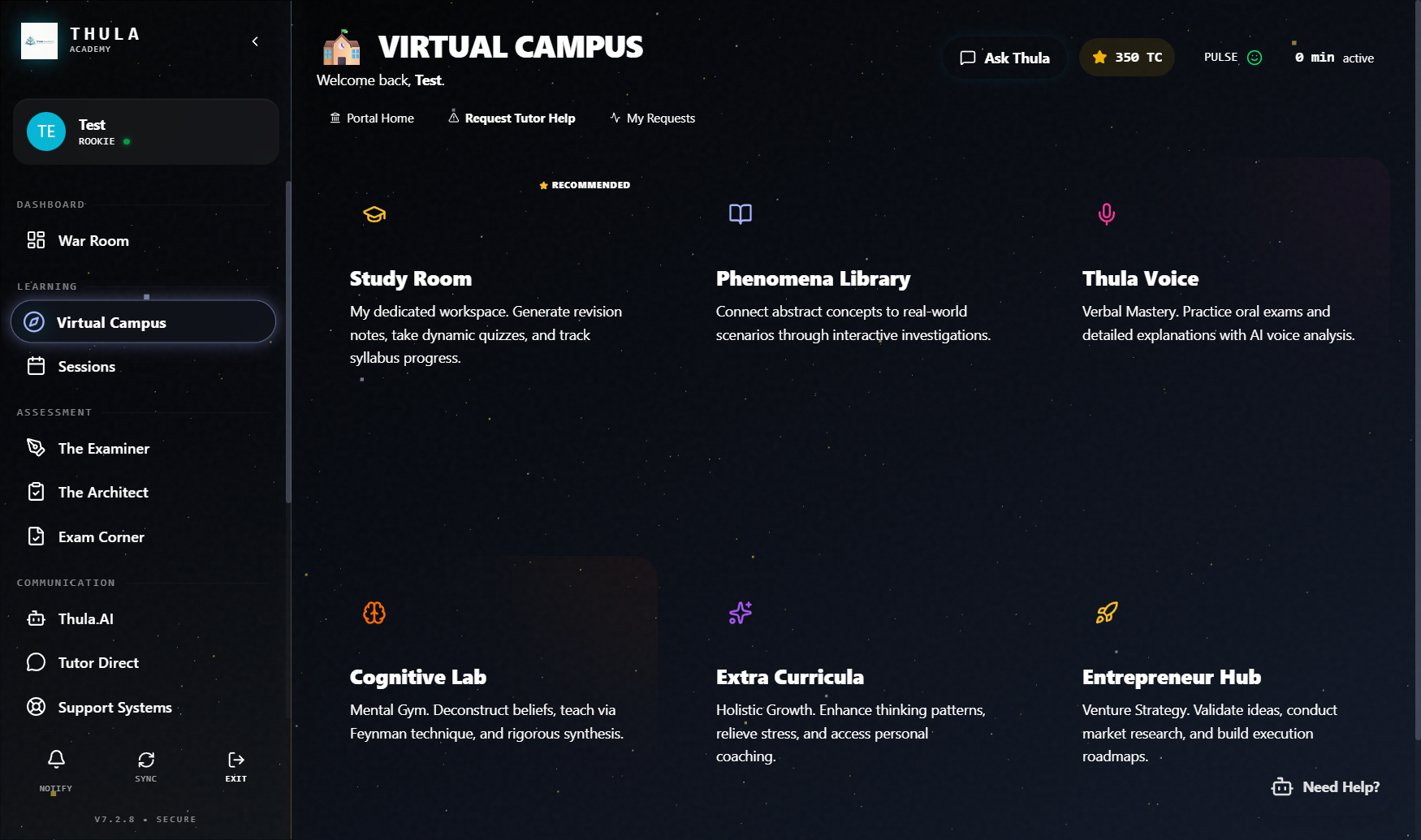
The War Room is one of my favorite features inside Thula Academy — and I say that as someone who's spent years working with students across AP, IB, and SAT prep. It's a deep behavioral analytics dashboard that surfaces the patterns underneath a student's learning. Not just "they completed 12 sessions this month." We're talking about meaningful, layered insight.
It tracks when students are most cognitively engaged versus when they're going through the motions. It identifies emotional patterns — does a student's performance drop on days following late-night sessions? Do they avoid certain topics without realizing it? It pulls together session data, assessment results, note-taking behavior, and tutor feedback into something that actually tells a story. And then it translates that story into concrete tutor recommendations.
Think of it less like a report card and more like a coaching debrief after a game. The kind where someone who was watching the whole time tells you exactly what they saw — and you finally recognize patterns in yourself that you couldn't see from the inside.
If you want to see what the full platform looks like, explore our tutoring plans — the War Room is available across all of them.
Walking Through a Real War Room Session
Let me show you what this actually looks like in practice. Back to Marcus.
When his tutor pulled up the War Room dashboard mid-semester, a few things jumped out immediately. First, Marcus was doing the bulk of his studying between 10pm and midnight. His session completion rate during those hours? Strong. But his quiz performance the following morning was consistently 15–20% lower than after daytime sessions. That's not a coincidence — that's a pattern, and it was hiding in plain sight.
Second, the War Room flagged something subtler: Marcus was spending disproportionate time in the Topic Studio on integration techniques, but he wasn't submitting practice questions on those topics to the Exam Paper Generator. He was reading. Re-reading. Never actually testing himself. Classic passive studying dressed up as active work. His brain felt productive. The data said otherwise.
Third — and this one genuinely surprised his tutor — the behavioral analysis showed elevated exit rates during any session that started with a timed element. Marcus would open a timed practice set, see the clock, and close the tab within four minutes on average. He wasn't skipping the work deliberately. He was avoiding the anxiety trigger entirely without even being conscious of it.
None of this came out in a single conversation. Students don't usually say "I think I have a conditioned stress response to timed assessments." They just say "I don't know, I studied a ton and it didn't work."
What Happened When We Actually Used That Data
Marcus's tutor restructured everything based on what the War Room surfaced. Study sessions moved to late afternoon. The passive reading habit got replaced with a strict active recall protocol — every topic in the Study Room had to end with a generated practice set, no exceptions. And the timed component anxiety? They addressed that head-on over two weeks, starting with untimed problem sets and gradually reintroducing the clock.
By the time AP exam season rolled around in May, Marcus's mock scores had gone from a projected 2 to a consistent 4. That's not magic. That's just finally having accurate information and doing something with it.
This is the part that matters to me as an educator: it wasn't about studying harder. It was about studying in a way that actually matched how Marcus's brain worked. The War Room made that visible. The tutor made it actionable.
Why Most Online Tutoring Misses This Entirely
Here's something I think about a lot. Most online tutoring — even good tutoring — operates on incomplete data. A student shows up, works through problems, gets feedback, leaves. The tutor builds a mental model of the student over weeks and months, mostly from what the student chooses to share. That's a limited dataset.
The students who benefit most from an online tutor aren't always the ones with the biggest knowledge gaps. Sometimes they're the ones with hidden behavioral patterns that are quietly undermining everything else. A brilliant student in a SAT math prep program who's tanking every second practice test because they always schedule it after soccer practice and they're mentally exhausted. An IB student in the US working toward their diploma who reviews notes constantly but never attempts past papers. These students don't look like they need intervention. The numbers say otherwise.
Personalised education — real personalization, not just "here's a different worksheet" — means understanding the full picture. That's what student analytics at this level can actually do.
For students who want to explore what this kind of adaptive, intelligent learning looks like before committing, try our free study tools and get a feel for how the platform works.
Who Gets the Most Out of War Room Data?
In my experience, three types of students see transformative results from the War Room insights almost immediately.
- High-effort, low-output students — the Marcus types. They're doing the time but something is broken in the process. The data almost always finds it fast.
- Students managing anxiety around exams — especially relevant for AP and SAT test-takers in the US where the stakes around college admissions are genuinely high. The behavioral patterns that emerge around stress are often the most actionable.
- Students who are self-directed but undirected — they don't need motivation, they need strategy. The War Room's tutor recommendation engine gives them exactly that: a clear, data-backed path rather than a vague "study more."
It's also enormously useful for parents who want visibility without micromanaging. The progress tracking is honest and specific — not just a reassuring green bar moving across a screen.
One Thing That Surprised Even Me
I'll be honest about something. When we first started building out the behavioral analytics layer for the War Room, I expected the biggest insights to be about content — which topics students struggled with, where knowledge gaps clustered. And yes, that's all there. But the patterns that turned out to matter most were almost always behavioral and temporal. When students studied. What they avoided. How their engagement shifted in the week before a major assessment.
The content gaps were fixable in a session or two. The behavioral patterns — those were the things keeping students from performing at their actual level. That's the non-obvious thing about student analytics done properly: it's not really about the subject. It's about the student.
If you're a parent, a tutor, or a student who's been pouring hours into AP Calculus, AP Statistics, IB prep, or SAT math tutoring and wondering why the results aren't reflecting the effort — that's exactly the question the War Room is built to answer.
Ready to see what it looks like for your own learning profile? Start your free 21-day trial and let's find out what your data actually says.
Marcus is doing fine, by the way. He got into his first-choice school. But more importantly, he finally understands how he learns — and that'll matter way beyond any single AP exam.
```

 Sri Lanka
 United Kingdom
 Australia
 Ireland
 Germany
 UAE
 Singapore
 USA