Why Math Feels 'Hard': The Trap of Methods vs. Mechanics of Truth
Students don't hate math. They hate being confused. And they are confused because they are taught recipes instead of chemistry.
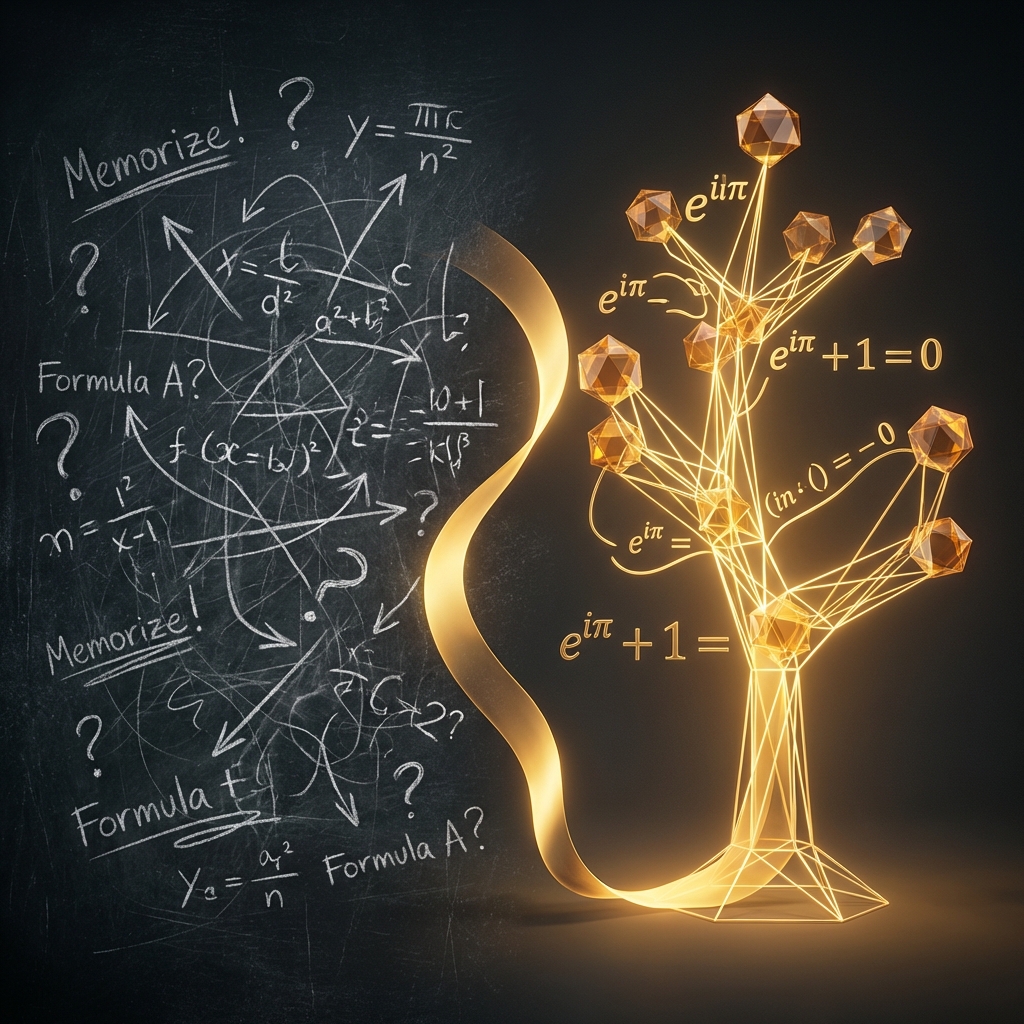
The "Method" Trap
Typical student: "To find the turning point, I differentiate and set to zero."
Grandmaster student: "To find the turning point, I'm looking for where the rate of change momentarily pauses. That means the slope is zero."
See the difference? The first relies on memory (fragile). The second relies on truth (robust).
Why? What? When?
Never learn a mathematical "method" without answering three questions:
- Why does this work? (The Proof/Logic)
- What is it actually doing? (The Visualization)
- When does it fail? ( The Constraints)
If you can't derives, you don't understand it. You've just memorized a spell.
Conceptual Learning in Action
Take integration. Rote learners see a long 'S' symbol and a list of rules.
Conceptual learners see summation. They see adding up infinitely thin slices to finding a total accumulation. Area, volume, distance—it's all just adding up slices.
When math is hard, it's usually because you skipped the "Why" to get to the "How". Go back. Build the foundation. The house will stand.