Decoding Statistics: Why You Must Master Definitions Before Distributions
Statistics is the most linguistic branch of mathematics. It depends entirely on precise definitions. If you treat "mean", "median", and "expectation" as synonyms, you will fail.
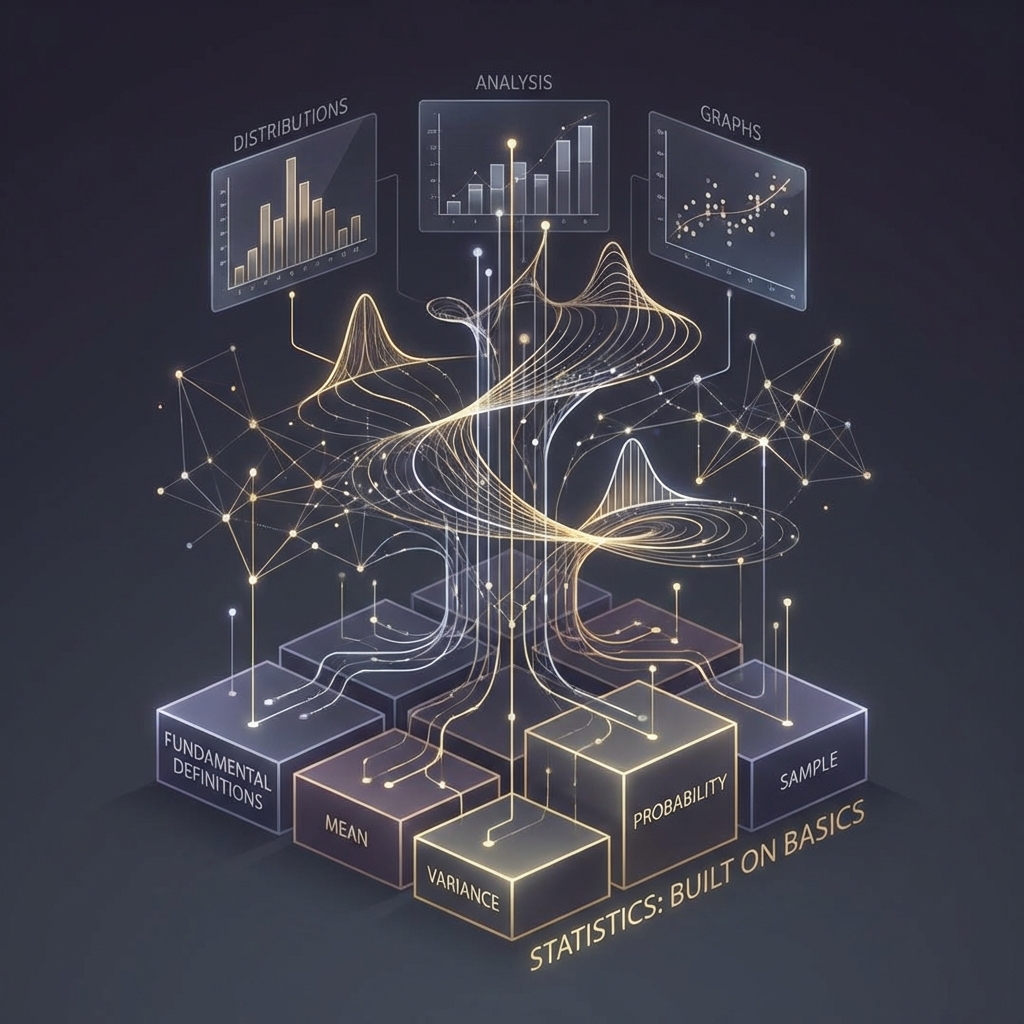
The Hierarchy of Knowledge
Most students jump straight to Hypothesis Testing or Normal Distributions. This is like trying to write poetry without knowing the alphabet.
Level 1: The Taxonomy (Definitions)
What is a random variable? What is a sample space? What is "mutually exclusive" vs "independent"?
Example: "Independent" means the outcome of A doesn't affect B. "Mutually Exclusive" means A and B cannot happen together. Students mix these up constantly. One is about probability interaction; the other is about existence.
Level 2: The Grammar (Probability Axioms)
How do we combine events? Union? Intersection? Conditional probability?
Level 3: The Literature (Distributions & Testing)
Only NOW should you touch Normal, Binomial, or Poisson distributions.
Why It Feels Hard
Statistics feels hard because it's subtle. In algebra, x is x. In statistics, X is a random variable that might be x.
The solution? Respect the definitions.
Don't say "average". Say "arithmetic mean". Don't say "spread". Say "standard deviation" or "variance". Precision in language leads to precision in thought.
Build the basement before you try to build the skyscraper.