University Data Science Foundations Tutor Online — Elite Online Tutoring | Thula Academy
Get expert data science tutor online for university students. Master data wrangling, ML fundamentals, statistical inference & Python/R. Plans from $40/month.
Expert University Data Science Foundations Tutoring Online
Data Science Foundations is one of the most demanding and rewarding courses in any university curriculum. It sits at the intersection of statistics, computer science, and domain expertise — requiring students to develop a unique blend of analytical thinking, programming proficiency, and mathematical rigour. At Thula Academy, our specialist data science tutors online help university students not only survive this course but truly excel in it, building skills that translate directly into one of the world's fastest-growing career fields.
What You'll Learn in Data Science Foundations
A typical university Data Science Foundations module spans an ambitious range of topics. Students begin with data wrangling and cleaning — the often-underestimated art of transforming messy, real-world datasets into structured, analysis-ready formats. This includes handling missing values, dealing with outliers, merging datasets, and reshaping data frames. From there, courses move into exploratory data analysis (EDA), where students learn to use summary statistics, distributions, and visualisations to uncover patterns and generate hypotheses before any formal modelling begins.
The mathematical backbone of the course covers probability for data science — including Bayes' theorem, conditional probability, random variables, and common distributions — followed by statistical inference, where students master hypothesis testing, confidence intervals, p-values, and the nuances of frequentist versus Bayesian approaches. These concepts form the foundation upon which all data-driven decision-making rests.
Students then explore core modelling techniques: linear regression for predicting continuous outcomes, classification methods such as logistic regression, decision trees, and k-nearest neighbours for categorical outcomes, clustering algorithms like k-means and hierarchical clustering for unsupervised pattern discovery, and dimensionality reduction techniques such as PCA for simplifying high-dimensional data. A dedicated module on machine learning fundamentals ties these methods together, introducing concepts like bias-variance tradeoff, cross-validation, regularisation, and model evaluation metrics.
On the technical side, students develop proficiency in Python and R programming — using libraries like pandas, NumPy, scikit-learn, ggplot2, and tidyverse — as well as SQL and databases for querying and managing relational data. Finally, data visualisation is woven throughout the course, with tools like Matplotlib, Seaborn, Plotly, and ggplot2 enabling students to communicate insights effectively.
Why Students Find Data Science Foundations Challenging
The sheer breadth of this course is its greatest challenge. Students are expected to shift rapidly between mathematical theory, statistical reasoning, and hands-on coding — often within the same assignment. Many struggle with the transition from clean textbook examples to noisy, incomplete real-world data. Programming errors in Python or R can be deeply frustrating, especially for students without a strong computer science background. Statistical inference, in particular, trips up many learners: misunderstanding p-values or confusing correlation with causation can lead to fundamentally flawed analyses. Additionally, machine learning concepts like overfitting, regularisation, and model selection require a level of intuition that takes time and practice to develop.
Exam Tips and Assessment Strategies
University data science assessments typically combine written exams testing conceptual understanding with practical coursework requiring end-to-end analysis of real datasets. For exams, focus on being able to explain why you would choose a particular method — not just how to implement it. Understand the assumptions behind linear regression, know when classification is appropriate versus clustering, and be prepared to interpret model output critically. For coursework, structure your analysis as a clear narrative: state your question, justify your data cleaning decisions, present exploratory findings, build and evaluate models, and communicate results with polished visualisations. Always include reproducible code with clear comments.
How Thula Academy Helps You Succeed
Our university data science help is delivered by tutors who hold advanced degrees in data science, statistics, and machine learning from top institutions. Every session is tailored to your specific course syllabus, whether you need help debugging a Python script, understanding the mathematics behind PCA, or preparing for a statistics exam. Our tutors use real datasets and interactive coding environments to make abstract concepts tangible.
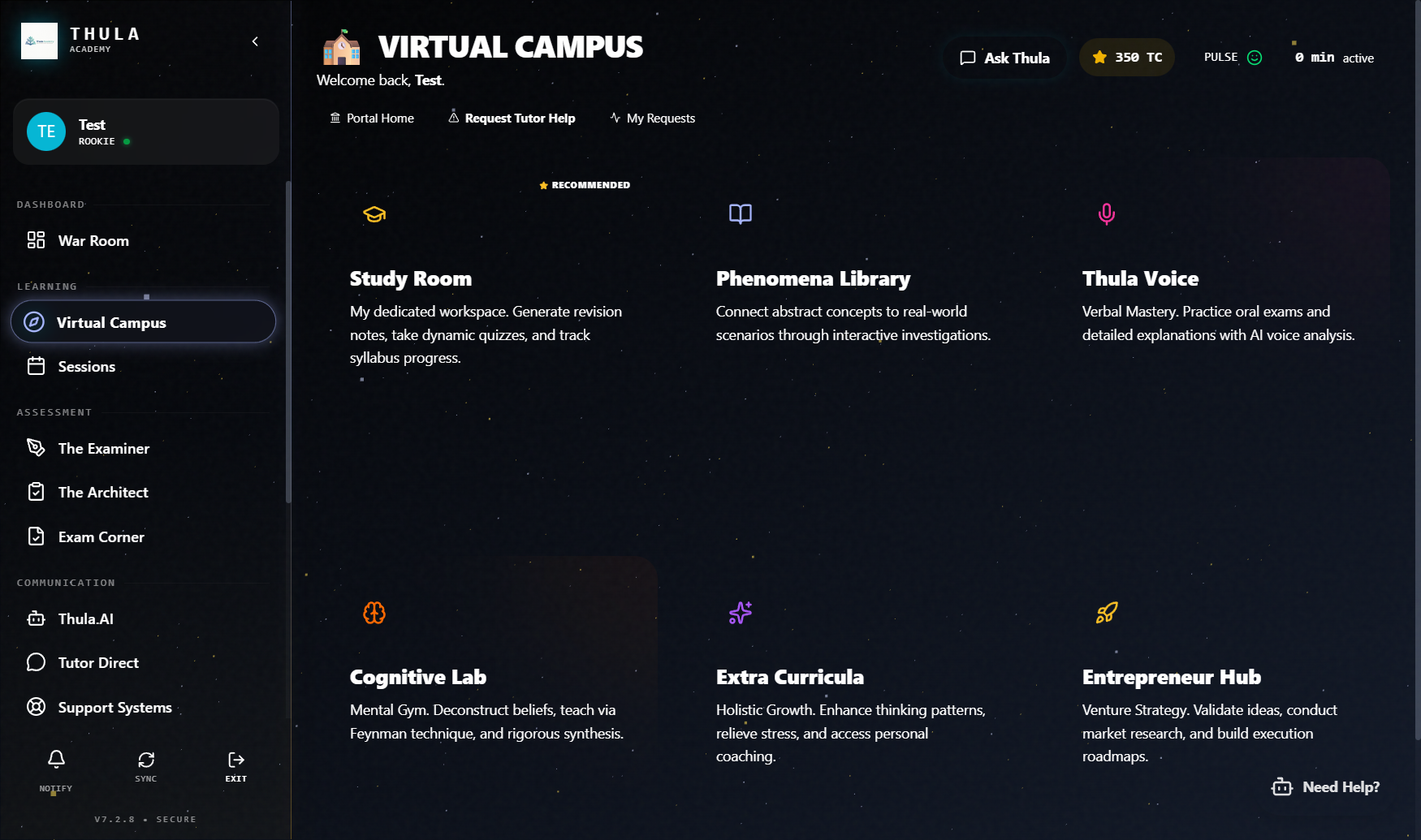
Thula Academy's Exam Corner feature generates custom practice papers based on your university's specific topic coverage, so you can rehearse under realistic conditions. Our adaptive learning platform identifies your weak areas — whether that's SQL joins, Bayesian probability, or scikit-learn pipelines — and provides targeted exercises and explanations to close knowledge gaps efficiently. With flexible scheduling and on-demand support, our college data science online tutor service fits around your lecture timetable and assignment deadlines.
Whether you're struggling with your first pandas DataFrame or fine-tuning a classification model for your final project, Thula Academy provides the expert, personalised support that makes the difference between confusion and confidence.


 Sri Lanka
 United Kingdom
 Australia
 Ireland
 Germany
 UAE
UAE Singapore
 USA
USA