Inside Thula Academy — Study Room: Tuesday, September 29
She Knew the Formula. She Still Failed the Question.
A student I was working with last year — let's call her Priya — was preparing for her H2 Mathematics paper under the Cambridge A-Level (Singapore syllabus). She'd done the notes. She'd watched the videos. She could recite the integration by parts formula without blinking. But when the actual exam question landed in front of her, she froze. Not because she didn't know the content. Because she'd never really understood it — she'd only memorised it.
That gap between knowing and understanding is the thing that quietly destroys exam results. And it's the exact problem the Study Room at Thula Academy was designed to close.
What the Study Room Actually Is
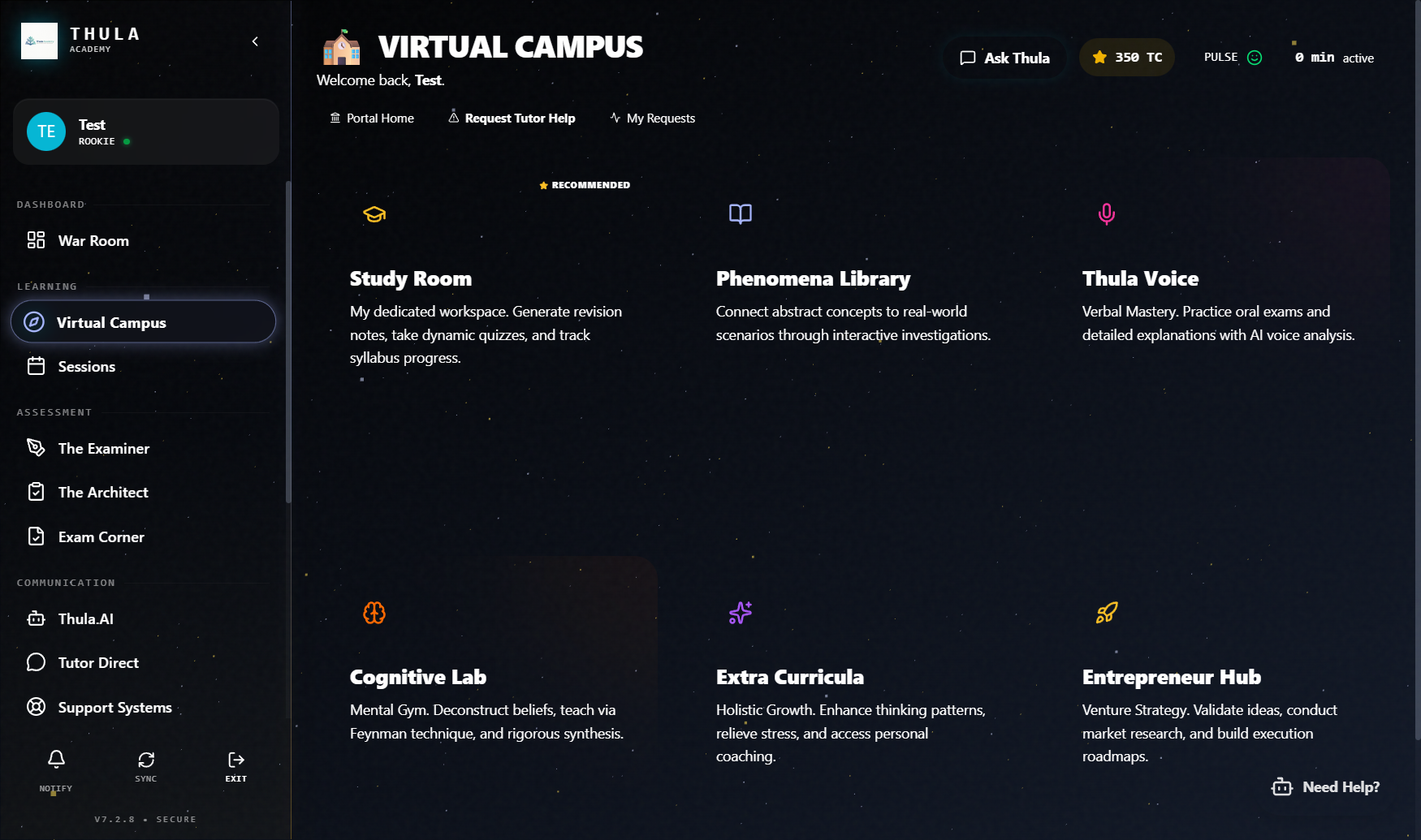
I want to be careful here, because "interactive learning space" sounds like something from a tech brochure. This is not that. The Study Room is where a student sits down with a topic — say, complex numbers, or market structures, or the nitrogen cycle — and works through it in a way that actually builds understanding, not just familiarity.
Here's how it works. Each topic is broken down into a logical teaching sequence. You're not just watching content passively — the Study Room checks in with you as you go. Comprehension checks appear at natural breakpoints, not as an afterthought quiz at the end. The system reads how you're doing and adjusts. If you breeze through something, it moves on. If you're struggling with a specific concept, it slows down, reframes, and works with you.
It's adaptive in the truest sense. Not just "harder questions if you get things right" — genuinely personalised paths through the material depending on what you actually need. If you're a JC2 student cramming before Prelims, the experience looks different from a Year 11 IGCSE student who has four months left. That distinction matters.
What a Real Study Session Looks Like
Let me walk you through what this looks like in practice, because I think that's where it clicks for most people.
Take Marcus — a JC1 student at a local independent school in Singapore doing both H2 Physics and Economics (yes, that combination exists, and yes, it's a lot). He opens the Study Room on a Wednesday evening, picks Circular Motion from his Physics topic list. He's been avoiding it. Most students avoid it. The pseudo-forces, the centripetal acceleration direction — it trips people up.
The Study Room doesn't just throw a wall of text at him. It starts with a short conceptual explanation — the kind where you actually picture a car going around a bend — and then immediately asks a comprehension check. Not a calculation yet. Just: "In this scenario, which direction is the net force acting?" Marcus gets it wrong. Picks the direction of velocity instead of toward the centre. The system doesn't just tell him he's wrong and move on. It pauses. Explains the distinction again from a different angle. Gives him a visual reference. Then asks again.
By the time Marcus is doing calculations twenty minutes later, he's not just plugging numbers into F = mv²/r. He actually understands why the force points inward. That's the difference. And that's what comprehension checks — done properly — make possible.
Why Most Online Tutoring Misses This Completely
Here's what I've noticed after years of working with students across Singapore, the UK, and Southeast Asia more broadly: most online tutoring platforms are really just content libraries with a chat function bolted on. Watch a video, read some notes, attempt a past paper, repeat. There's no feedback loop in the actual learning process — only at the very end, when the damage is already done.
That's not a dig at anyone. Building a genuine feedback loop inside the learning experience is genuinely hard to do well. The Study Room does it because the comprehension checks are embedded into the topic flow, not appended to it. You're being assessed while you learn, not after.
And honestly? That's closer to how a good human tutor actually works. When I'm sitting with a student going through organic chemistry reaction mechanisms, I'm not delivering a lecture for forty minutes and then quizzing them. I'm watching their face. Asking small questions mid-explanation. Catching the moment they lose the thread and backing up. The Study Room does a version of that — systematically, for every student, on every topic.
If you're looking for a proper free study tool to explore before committing to anything, start there and see what I mean.
The Personalised Study Path — This Is the Part I'm Most Proud Of
Every student who uses the Study Room ends up with a personalised study path — a live, updated map of what they've covered, what they understand well, and where the gaps are. For IB Diploma students at international schools in Singapore managing six subjects simultaneously, this is not a luxury. It's survival infrastructure.
The path isn't static. It changes as the student works. If you nail Sequences and Series in H2 Maths but stumble on Maclaurin's Theorem three weeks later, the system flags the connection and loops back intelligently. Because those two topics are linked — and a student who doesn't see that link is going to have a bad time in Paper 1.
This is what personalised education actually means in practice. Not "choose your own video from a menu." A genuinely responsive study experience that knows where you are and where you need to be.
What Changes for Students Who Use It Consistently
The shift I've seen — and I want to be precise about this — is not in confidence scores or engagement metrics. It's in how students talk about topics after a few weeks of using the Study Room regularly.
They stop saying "I know this topic." They start saying "I understand this topic." Those are not the same sentence. Students who understand material can handle unseen questions, unfamiliar contexts, weird exam twists. Students who merely know it can only handle what they've already seen.
For Cambridge A-Level students in Singapore — where Paper 3 in H2 Maths or the synoptic questions in A-Level Biology are specifically designed to reward deep understanding over rote recall — this distinction is everything. The examiners write those papers knowing most students have memorised the content. They're trying to find the ones who actually get it.
The Study Room builds those students. That's the whole point of it.
A Few Things Worth Knowing Before You Start
- It works across subjects. Maths, Economics, Chemistry, Psychology, Computer Science — the Study Room covers all of them with curriculum-aligned content for Cambridge, IB, and more.
- It works at your pace. There's no timer anxiety built into the learning phase. The comprehension checks are firm but not punishing.
- Progress is tracked properly. Not just "topics completed" but depth of understanding per subtopic — genuinely useful data for students and parents who want to know where the real work needs to happen.
- It pairs well with live tutoring. A lot of students use the Study Room to prepare for their sessions with a tutor, so they're going in with specific questions rather than vague confusion. That's a much better use of everyone's time.
So — Try It
If you're a JC student in Singapore staring down your A-Level examinations, or an IB student trying to hold together HL subjects across three different syllabuses — or honestly, if you're anywhere in the world working toward an exam that actually matters — the Study Room is worth your time.
You can start a free 21-day trial and get into the Study Room immediately. No setup faff. Just pick a topic that's been bothering you and see what happens in the first session.
And if you want to understand how the broader platform fits together — the War Room, the Exam Corner, the Exam Paper Generator — our tutoring plans page has a clear breakdown of what's included at each level. No surprises.
Priya, by the way — she passed her A-Levels. Distinction in H2 Maths. She told me afterwards that the thing that changed wasn't how much she studied. It was that she finally stopped confusing memorisation with understanding. The Study Room didn't do that for her magically. But it gave her the structure and the honest feedback to figure it out herself.
That's what good education looks like. And it's what we built the Study Room to do.
```

 Sri Lanka
 United Kingdom
 Australia
 Ireland
 Germany
 UAE
UAE Singapore
 USA
USA